Headgear- Form, Function, and Fame
- Jay Bebin

- Apr 29, 2020
- 3 min read

During the Napoleonic Era, French soldiers began to wear a "Shako"a tall, conical cap with a visor that was topped with a tiny feather. Just prior to the Civil War, the US military had their own Shako as seen in the picture of an 1854 Infantry Shako.

The model 1858 (M1858) forage cap evolved directly from the shako used by the regular army earlier in the 1850s. They were less-expensive and more comfortable version of the earlier shako with the stiffening removed. This caused the hat disc to flop forward and was described by many soldiers as being “shapeless as a feedbag." The brim was a wider and somewhat flatter style.


The M1861 forage cap features the round sloping (crescent shaped) leather brim, made popular by General Irvin McDowell. Often called the "bummer's cap." (Bummers was a nickname applied to foragers of Maj. Gen. William Tecumseh Sherman's Union army during its March to the Sea and north through South Carolina and North Carolina during the American Civil War.)

The Kepi had a sunken top and squared visor and was often called a "McClellan cap", after the Union commander of the Army of the Potomac, G.B. McClellan. Although worn by both sides, it was mainly worn by officers. US Officer's Kepis are made of dark blue wool with black braid. Braid by Rank is: 2nd Lieutenant - none, 1st Lieutenant - 1 row, Captain - 2 rows, Major - 3 rows, Lt. Colonel - 4 rows, Colonel - 5 rows. By U.S. Regulation, Generals wore the Chapeau hat for dress occasions. No braided caps are listed for Generals in the regulations, however, a few Generals did devise their own and had them made by hatters. Corresponding rows of braid can be added horizontally at the top of the band.


The kepi was also popular with various state units and as privately purchased headgear. The 84th New York Infantry Regiment (14th Brooklyn Infantry Regiment) was one such regiment that wore a special kepi at the Battle of Gettysburg. It was made with a dark blue base, red sides, dark blue top, and red circular insert.


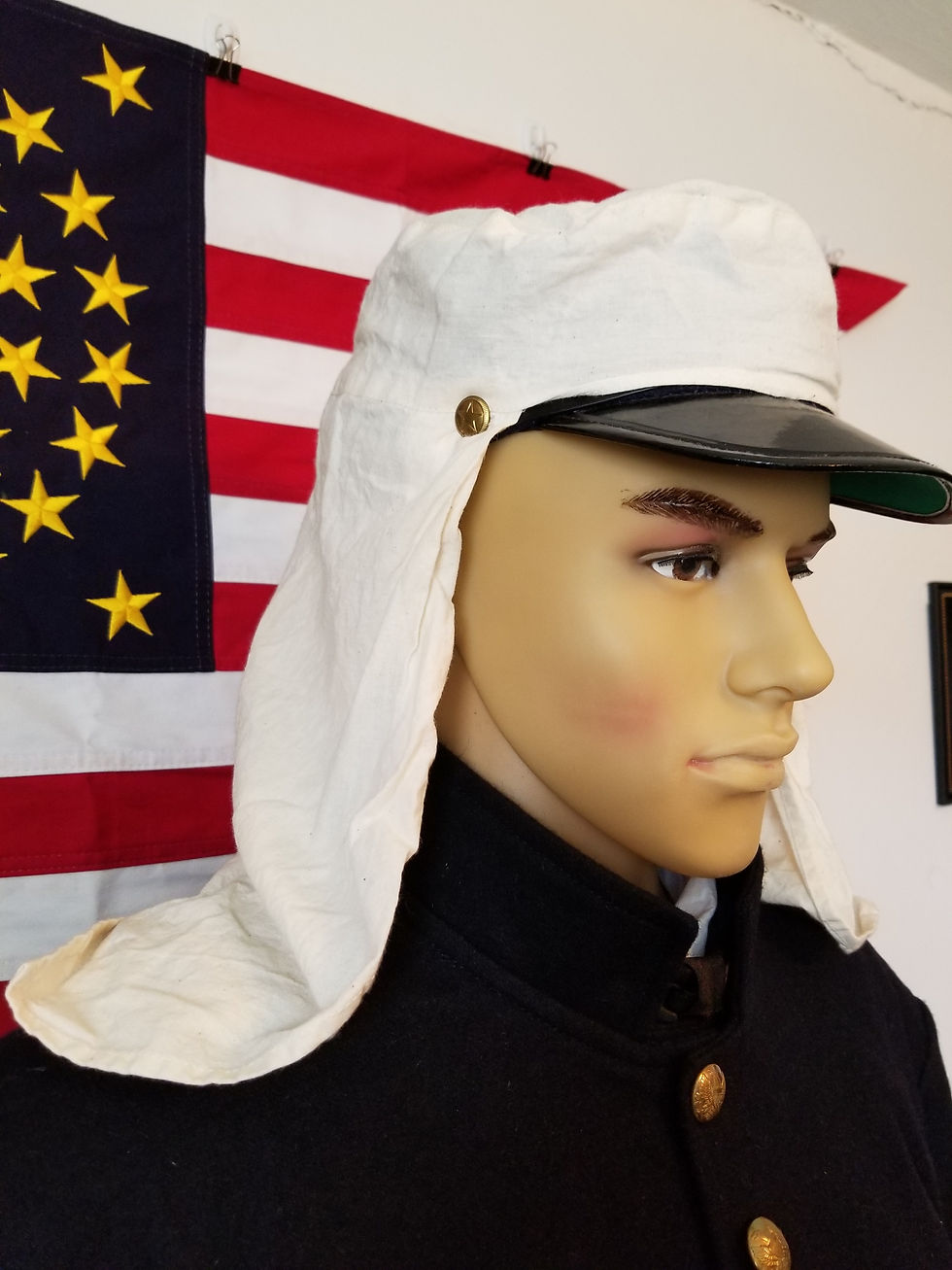
HAVELOCK- A havelock is a cover for the kepi protecting the wearer's neck to prevent sunburn. The havelock buttons on to the exterior of the kepi using the kepi band buttons. Most havelocks were repurposed early on as they were found to be very hot due to limiting air circulation.


Model 1858 Dress Hat, also known as the "Hardee Hat", was the regulation dress hat for enlisted men in the Union Army. (The hat apparently was named after William J. Hardee, a career officer in the U.S. Army from 1838 until resigning his commission on January 31, 1861. Hardee was Commandant of Cadets at West Point from 1856 to 1860. It is said that he designed this hat sometime in 1860.) The 1861 U.S. Army regulations specify the hat be adorned with a brass hat device designating corps, brass regiment number, brass company letter, and a wool hat cord denoting the branch of service of the wearer: sky blue for infantry, red for artillery, yellow for cavalry, crimson for ordnance, and green for mounted riflemen. The brim to be pinned up, with a brass eagle (Jeff Davis pin), on the right side for cavalrymen and artillerymen, and on the left for infantry soldiers. They would also be adorned with black ostrich plume.


"Jeff Davis" or brass eagle hat pin- In 1855, Secretary of War; and future President of the Confederacy, Jefferson Davis directed the formation of two new regiments of cavalry. A group of officers, appointed to make equipment recommendations, suggested a flamboyant new hat for the cavalry. (William Hardee had assumed the position of Senior Major in one of these regiments) The hat pin, and sometimes the hat, is often referred to as the “Jeff Davis” pin/hat. This is mostly due to the fact that the hat was introduced during his tenure as the Secretary of War. The Hardee hat was also worn by Confederate soldiers.

The most famous and easily recognized Hardee hats were worn by the Union Army's Iron Brigade. The 2nd, 6th, & 7th Wisconsin, 19th Indiana, & 24th Michigan regiments made up the popularly named and now famous "Black Hats."


A slouch hat is a wide-brimmed felt or cloth hat most commonly worn as part of a military uniform. It was made of black felt and commonly worn by Union Officers during the Civil War. At the Battle of Gettysburg, two of the most notable Union General's who wore slouch hats were George Meade and John Buford.


Comments