What's That On Your Hat?
- Jay Bebin

- May 6, 2020
- 4 min read
Besides being a regulation, the items affixed to a soldiers hat provided a great deal of information. Before I get into all of that, I think it is important to understand exactly how the Army of the Potomac was organized.
COMPANY- This was the most basic part in the organization of the army. It normally consisted of about 100 men and was led by a Captain. Companies were named with letters from A-K but did not use J because it was too much like I.
REGIMENT- They were normally made of 10 companies or roughly 1,000 men and led by a Colonel.
BRIGADE- Usually consisted of 4 regiments or 4,000 men commanded by a Brigadier General.
DIVISION- Contained between 3-5 regiments or approximately 12,000 men commanded by a Major General.
CORPS- Comprised of an average of 3 divisions or about 36,000 men and commanded by a Major General.
ARMY- Named normally after waterways or rivers for Union forces. They were made of 1 to 8 corps and commanded by a General.
Hopefully this will help in understanding the importance of what was worn on the hat. Exactly how items were worn on the forage cap or enlisted kepi only had one regulation;
1493. For fatigue purposes, forage caps, of pattern in the Quartermaster-General's office: dark blue cloth, with a welt of the same around the crown, and yellow metal letters in front to designate companies.
The Hardee hat worn for parade or formal occasions had the following regulations;
1488. For Enlisted Men, except companies of Light Artillery--the same as for officers of the respective corps, except that there will be but one feather, the cord will be of worsted, of the same color as that of the facings of the corps, three-sixteenths of an inch in diameter, running three times through a slide of the same material, and terminating with two tassels, not less than two inches long, on the side of the hat opposite the feather. The insignia of corps, in brass, in front of the hat, corresponding with those prescribed for officers, with the number of regiment, five-eighths of an inch long, in brass, and letter of company, one inch, in brass, arranged over the insignia.

1485. For Officers of Cavalry--the same as for the General Staff, except the ornament in front, which will be two gold-embroidered sabres crossed, edges upward on black velvet ground with the number of the regiment in silver in the upper angle.
1486. For Officers of Artillery--the same as for the General Staff, except the ornament in front, which will be gold-embroidered cross-cannon, on black velvet ground with the number of the regiment in silver at the intersection of the cross-cannon.
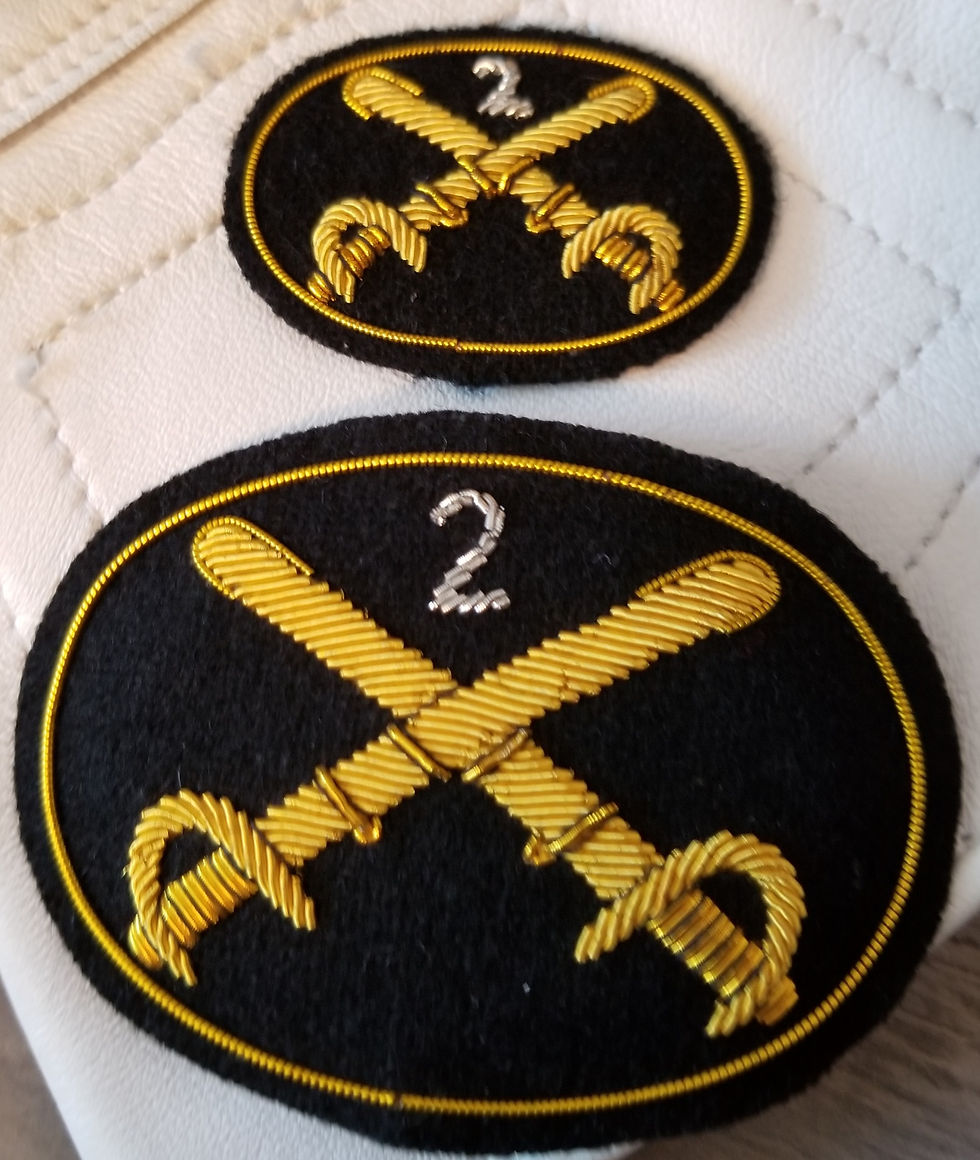
1487. For Officers of Infantry--the same as for the General Staff, except the ornament in front, which will be a gold-embroidered bugle, on black velvet ground with the number of the regiment in silver within the bend.

The stamped brass numbers, letters, and branch insignia were affixed to the hat with thin wire. Because of this, many of these would be lost in battle or during everyday activities..

These are the wires from inside the Cavalry Hardee hat.

The hat below is a reproduction of an Iron Brigade hat from the 2nd Wisconsin Company C. Putting the number in the bend or in the upper angle of the crossed-sabers or canons was fine if you were in the 1st to 9th regiments.

Here is an example of a reproduction 149th Pennsylvania Bucktails hat.

What if you were in the 2nd Delaware, 2nd New Jersey, or 2nd New Hampshire? How would you know the difference? That is exactly what happened to Major General Phillip Kearny. He had reprimanded some officers who were not under his command for not following orders, but they were under the orders of another general. He ordered the men of his division to wear a 2 inch red square cloth to their hats or left breast of their coat to keep this from happening again. After assuming command of the Army of the Potomac, Major General Joseph Hooker adopted this idea so that men could be identified at a distance. The Corps Badges were designated as follows:
Headquarters Army of the Potomac, March 21, 1863.
For the purpose of ready recognition of corps and divisions of the army, and to prevent injustice by reports of straggling and misconduct through mistakes to their organizations, the chief quartermaster will furnish, without delay, the following badges to be worn by the officers and enlisted men of all regiments of the various corps mentioned. They will be securely fastened upon the centre of the top of the cap. The inspecting officers will at all inspections see that these badges are worn as designated.
First Corps - a sphere: red for the First Division; white for the Second; blue for the Third.
Second Corps – a trefoil: red for the First Division; white for the Second; blue for the Third.
Third Corps – a lozenge: red for the First Division; white for the Second; blue for the Third.

Fifth Corps – a Maltese cross: red for the First Division; white for the Second; blue for the Third.

Sixth Corps – a cross: red for the First Division; white for the Second; blue for the Third. (Light Division, green.)

Eleventh Corps – a crescent: red for the First Division; white for the Second; blue for the Third.

Twelfth Corps – a star: red for the First Division; white for the Second; blue for the Third.

The sizes and colors will be according to pattern.
By command of Major-General Hooker,
S. Williams, Acting Adjutant-General.
In the example hats above, the Corps badge is under the bugle to be shown thru the bend. Red Sphere/Circle for 1st Corps, 1st Division. Then the very faded Blue Sphere/Circle for 1st Corps, Third Division.
Here are some other examples of how the Corps badges were worn;

A hat worn by Sergeant Philander B. Wright, Color Sergeant, Company C, 2nd Wisconsin Volunteer Infantry Regiment at Gettysburg- 1st Corps, 1st Division

1st US Sharpshooters (Berdan's Sharpshooters) 1st Corp, 1st Division.

Aged reproduction 20th Maine Officers kepi. Fifth Corps, 1st Division.
The hat was very important in telling who was who on the battlefield, and unfortunately all too often helped to identify the fallen as the dog tag had not yet been invented. (But that's a discussion for another BLOG)


Comments